<!doctype html>
Why Your Sherman Oaks Trees are Killing Your Sewer Line
Why Your Sherman Oaks Trees are Killing Your Sewer Line
Sherman Oaks, CA sits on mature landscaping and aging underground infrastructure. The neighborhood carries high-value homes, layered hardscaping, and thick root systems from decades of growth. Those roots chase moisture. Old vitrified clay pipe and cast iron joints leak. The result is steady root intrusion, cracked sewer pipe walls, bellied sections from soil movement, and backups that seem to hit at the worst moment. Trenchless sewer repair in Sherman Oaks solves this without destroying driveways, walkways, or established trees.
Why trees love your sewer lateral
Tree roots find water and nutrients by sensing vapor and small leaks in the soil. A sewer lateral with porous joints or pinholes gives off both. Vitrified clay pipe has jointed sections every few feet. Those joints often lack watertight gaskets in older installs. Cast iron corrodes on the crown and at the joints, creating pits that vent moisture. Even newer PVC or ABS lines can allow roots in at poorly glued joint connections or damaged cleanout caps. Once a rootlet finds the line, it thickens into a woody mat. That mat traps solids, triggers slow drains, and grows back between cleanings.
Local tree species in Sherman Oaks push this behavior. Ficus near Ventura Boulevard grow aggressive surface roots that exploit tiny openings. Jacaranda roots thread through fractured clay and widen the gap each season. Liquidambar and camphor press deep, especially near irrigation lines. On hillside streets in Sherman Oaks Hills and Royal Woods, roots also chase groundwater that follows the bed of a trench where the lateral was buried decades ago. The trench backfill often settles, causing bellies. Bellied pipe sections hold water and organic debris. That standing water feeds roots and speeds corrosion in cast iron.
The local infrastructure problem behind the backups
Much of Sherman Oaks uses vitrified clay pipe for laterals built in mid-century years. Many homes also keep original cast iron under the slab. Over time, the clay joints open and the cast iron scales on the inside. Descaling can restore bore size, but it does not fix joint integrity. Some homes still have Orangeburg pipe, a bituminized fiber pipe from the post-war era. Orangeburg blisters and deforms under load and heat. Once roots get in, the deformation worsens.
Soil conditions compound the issue. Near the Sepulveda Basin and Van Nuys Sherman Oaks Park, the soil carries more fines and holds moisture. That supports root masses near the lateral. In hillside zones like Longridge Estates and Deervale-Stone Canyon Park, differential settlement and seasonal movement shear clay joints and create offsets. Near busy corridors like Ventura Boulevard and the Sherman Oaks Galleria area, traffic vibration and utility congestion add stress. The common failure modes show up as root intrusion, cracked sewer pipe walls, bellied pipe segments, and occasional sinkholes along the lateral path.
Homeowners see the result inside. The main sewer line backs up during laundry day. A gurgling toilet near a remodeled bathroom hints at air binding in a line packed with roots. Kitchen drains fizz after rain because groundwater seepage and root mats reduce flow. A faint sewage odor in a side yard signals a joint leak right where a ficus hangs over the fence line. These are classic Sherman Oaks patterns, seen block after block in 91403 and 91423.
Spot the warning signs before a full blockage
Most failures give notice before the big overflow. Homeowners in Chandler Estates, Magnolia Woods, and Hidden Woods can use a quick field checklist to decide when to call for a camera.
- Recurring backups across multiple fixtures point to root intrusion in the main sewer line.
- Gurgling toilets after showers suggest a partially blocked sewer lateral, often at a clay joint.
- Sewage odors in the yard or garage often track to a cracked cast iron pipe or failed cleanout cap.
- Lush green patches or soggy soil above the lateral indicate an underground leak that feeds roots.
- Slow drains that improve after rain can signal a bellied pipe that holds water and debris.
Do not ignore damp soil near the foundation or unexplained foundation leaks. In a few cases that moisture comes from a broken lateral under the slab. A leak near the toilet flange may hint at a failed under-slab connection rather than a surface plumbing issue.
Diagnostics that respect driveways, turf, and hedges
Accurate diagnosis guides the right trenchless repair. A sewer camera inspection through the cleanout shows the line size, material, and defects. Crews in Sherman Oaks use Ridgid camera systems with transmitters to mark points of intrusion or a collapsed section from the surface. That way, any point repair or pull pit can land within a square foot or two, even in tight setbacks near Ventura Boulevard or along narrow drives in Royal Woods.
A proper inspection often starts with cleaning. Hydro jetting removes grease and loose root hair. If thick cast iron scale blocks the camera, a Picote high-speed descaling tool scrapes the bore to near-original diameter. That makes the video honest. It also sets the surface for a strong bond if a CIPP liner will be installed. If the line is packed with fibrous root masses in clay joints, the jetter and a root cutter clear the path. The crew documents footage around each joint connection, any bellies, and any offset that could snag a liner or calibration tube.
In older streets near the Van Nuys and Studio City borders, manholes sometimes give access for a downstream view to verify landing points. If the home lacks a usable cleanout, installing a new cleanout per Los Angeles County code helps both inspection and future maintenance. That small change pays for itself in a single emergency avoided.
Why trenchless sewer repair fits Sherman Oaks
Many Sherman Oaks lots stack value above the line. Stone driveways, brick ribbons, mature hedges, and pool decks sit on top of the path between the house and the city connection. Traditional trenching risks thousands in hardscape damage and weeks of disruption. Trenchless technology bypasses that. It rebuilds the pipe from the inside or swaps it along the same path with two small access points. The lawn stays intact. The driveway remains open. Neighbors along 91403 and 91423 appreciate the quiet and clean workflow.
Trenchless methods also solve the specific problem that trees cause. Roots enter at joints and seams. Trenchless lining removes those joints by creating a seamless pipe within a pipe. Pipe bursting replaces the old host pipe with new continuous HDPE. Both methods remove pathways that roots use. That is the permanent fix to chronic root intrusion.
The engineering behind CIPP and pipe bursting
Two main trenchless methods fit most Sherman Oaks laterals. Each method picks up where trees and time have hurt the original line.
CIPP: epoxy lining that seals out roots
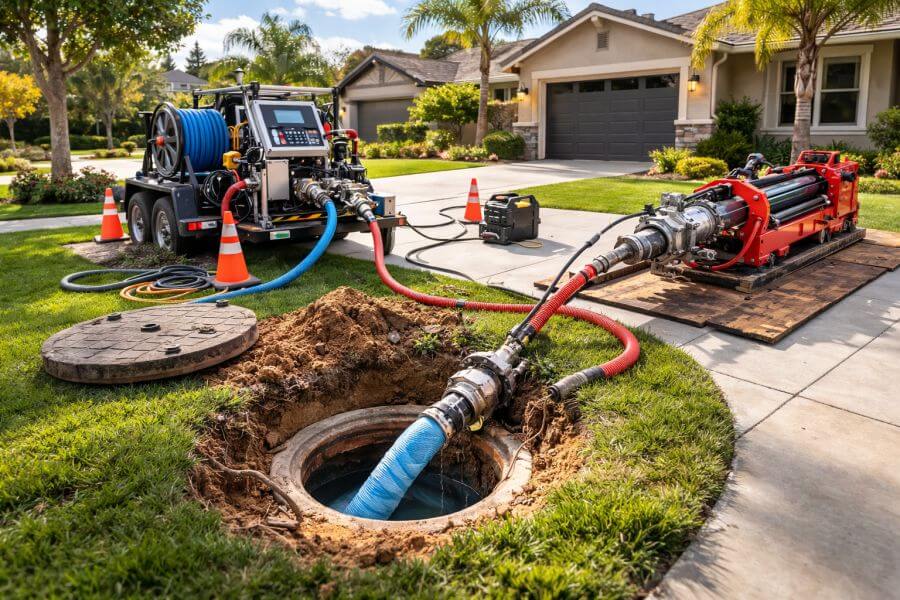
CIPP stands for cured-in-place pipe. The installer inverts or pulls a resin-saturated felt or fiberglass tube into the existing sewer lateral. An internal calibration tube expands the liner to press tight against the host pipe. The crew cures the resin using hot water or steam. The resin hardens into a seamless, structural pipe. The result is a smooth bore with no joints for roots to enter. In clay, this eliminates the weak points. In cast iron, it stops corrosion and leakage. Premium systems from Perma-Liner and NuFlow support laterals with bends and transitions. Many crews use IMS Robotics cutters to reopen branch lines and the cleanout after curing. The lined section often carries a 50-year pipe lifespan rating and meets IAPMO standards when installed by a licensed team.
Technical details matter. A proper ASTM F1216 design sets wall thickness based on soil load, groundwater, and host pipe condition. In Sherman Oaks Hills, the crew may upsize the liner thickness to account for hillside loads. Epoxy selection depends on temperature and cure time. Winter mornings in the Valley may drive a steam cure to lock timing. Summer afternoons can allow an ambient cure with tight process control. A Ridgid camera verifies that the liner sits tight and smooth. The crew reinstates any covered connection using robotic precision and then records the final result for the homeowner.
Pipe bursting: new HDPE where clay failed
Pipe bursting replaces the host pipe along the same alignment. The crew digs a small launch pit near the house and a receiving pit at the property line or manhole. A bursting head splits the clay or cast iron. It drags a continuous HDPE pipe into place behind it. The new pipe has fused joints that are stronger than the pipe wall. There are no seams for roots. HammerHead Trenchless systems are common for controlled bursts in tight residential lots. This method is ideal for crushed Orangeburg, severely offset clay, or a collapsed cast iron section that a liner cannot bridge. It also works well where multiple sags would trap water under a liner. Bursting lets the crew correct grade and restore flow with a new, uniform slope.
Point repair is a third option if damage is isolated. A short CIPP patch seals a single joint or crack without lining the whole run. It is a focused fix near a ficus root mass or at a shifted coupling under a driveway ribbon. This protects budget while preventing root re-entry at that failure point.
Will trenchless work under slabs, pools, and drives
Many Sherman Oaks homes still run cast iron under the slab with a transition to clay in the yard. Trenchless point repairs can seal a single under-slab crack near a toilet flange connection. Full lateral lining can start at the cleanout and finish at the city connection in the street or alley. If the line crosses under a pool deck in Magnolia Woods or a stamped driveway near Westfield Fashion Square, trenchless saves those finishes. Bursting often needs only two pits in planters or turf zones. Lining usually needs one surface access at the cleanout. In rare cases with no access, a new cleanout is installed in a small, tidy excavation and set back to grade.
Under-slab cast iron that is too thin to line may call for reroute plumbing rather than lining. A camera and wall-thickness gauge after descaling will tell that story. Where floors are historic or radiant-heated, lining between the flange and the yard connection can still resolve 90% of risk. The under-slab section may then be handled with a short point liner or a precise epoxy repair if the structure allows. This is judgment work based on years of local experience and full video proof.
Dealing with bellies, offsets, and collapses
Not every line is a clean candidate for a straight liner. Bellied pipe sections hold water. A liner will bridge minor bellies, but severe sags can trap flow. An experienced crew will measure the sag length and depth. If it is shallow and short, the liner’s smooth bore reduces turbulence and passes waste better than before. If the belly is long or deep, pipe bursting corrects the grade. Offsets at clay joints also need judgment. A small offset can be planed out with a Picote grinder before lining. A severe offset or a missing section means pre-excavation or bursting is safer.
Complete collapses do occur under old driveways in Chandler Estates or near mature oaks in Royal Woods. In those cases, bursting with an HDPE replacement pipe and a clean gravel bed often restores service the same day. If the collapse sits under the street, coordination with Los Angeles Bureau of Sanitation may be needed. A Licensed C-42 Sanitation System Contractor knows those steps and will handle permits and traffic control. That is part of keeping neighbors happy and the schedule tight.
What this means for homes near Ventura Boulevard and the Galleria
Homes close to Ventura Boulevard and the Sherman Oaks Galleria see heavier daytime flows and more traffic constraints. Crews plan staging to protect storefront access and HOA rules for mixed-use buildings near 91411. In quiet cul-de-sacs of Longridge Estates and Sherman Oaks Hills, trucks set up without blocking driveways. Near Van Nuys Sherman Oaks Park and the Sepulveda Basin, groundwater levels can rise after rain. That affects curing strategy and liner design. These details influence success. A local team fixes these variables daily and designs the repair around them.
Neighboring service areas all feed the same practices. Studio City, Encino, Valley Village, Bel Air, and Beverly Crest share the same clay and cast iron history. The same root behavior appears under similar irrigation and soil patterns. A crew that works across these zones learns the edge cases that books do not show, and that shows in fewer callbacks and cleaner final videos.
Materials, brands, and standards that hold up for decades
Diagnostics run on Ridgid cameras because parts and service are easy to source locally at vendors homeowners know, like Home Depot or Lowes, though professional supply houses carry deeper inventories. For CIPP, established systems from Perma-Liner and NuFlow provide consistent resin chemistry and tested liners. Robotic reinstatement and precision cuts often use IMS Robotics. Pipe bursting tool sets from HammerHead Trenchless handle clay and cast iron breaks cleanly. Picote equipment makes short work of hard cast iron scale before lining. New pipe for bursts is HDPE with heat-fused joints. It resists root intrusion by design.
Installers meet IAPMO standards on materials and process. That keeps building departments and inspectors aligned and gives the homeowner stable warranty terms. A 50-year pipe lifespan for a liner or HDPE burst is realistic when the system is installed to spec, the host pipe is prepared well, and access points seal tight. That is the baseline for work in Sherman Oaks zip codes 91403, 91423, 91411, and the 91495 mail code zone.
How long it takes and what it costs
Most trenchless jobs in Sherman Oaks run in hours, not days. A single-run lateral lining from a cleanout to the property line can finish same day, including hydro jetting and reinstatement. A pipe bursting replacement with two small pits often wraps within a day. Multi-branch systems or under-slab point repairs can span two days if descaling and extra reinstatements stack up. Night or early morning work near Ventura Boulevard can fit business traffic needs.
Costs vary by length, depth, access, and damage. A short point repair runs far less than a full lining. A burst with two pits differs from a burst that needs three pits to manage bends. Excavation on a hillside needs shoring and careful spoil handling. Any honest company will show the camera video, mark the surface, and explain each choice before quoting. Financing options help spread the cost on higher-scope repairs, and that keeps projects moving before the next root bloom blocks flow again.
Preventing the next root invasion
After the repair, a few habits protect the investment. Protect the cleanout and keep the cap tight. Avoid aggressive root-pruning that shocks trees and drives new feeder root growth toward water leaks. Set irrigation to sensible cycles so the soil does not swing from dry to saturated every few days. Plan hydro jetting maintenance for unlined secondary lines like kitchen laterals that were not part of the trenchless scope. If the property is below street level, an IAPMO-compliant backwater valve installed at the right elevation can stop city surges from pushing debris back into the private line during heavy storms.
Where trenchless beats a band-aid cleaning
Snaking and hydro jetting clear blockages, but they do not stop roots from coming back. The growth curve in Sherman Oaks is reliable. Root mats reform in months where a clay joint leaks. Frequent cleanings scar the host pipe and shorten its life. A trenchless liner seals the leak and removes joints. Pipe bursting removes the weak host pipe. Those moves shift service from reactive to stable. For homeowners in 91403 and 91423, that stability protects bathrooms, kitchens, and flooring from surprise overflows. It also protects driveways, gates, and hardscaping that define the property value in Chandler Estates, Royal Woods, and Magnolia Woods.
Answers to common questions from Sherman Oaks homeowners
Does trenchless work on a line with sharp bends. Yes, most laterals in Sherman Oaks carry two or three 45-degree bends. Modern liners and bursting rods handle that with planning. A tight 90-degree under a slab may require a short excavation or a reroute. The camera video will make that decision obvious.
Will a liner reduce the pipe size too much. A residential liner reduces the internal diameter by a small fraction. The smooth epoxy finish reduces friction and supports better flow than a rough, root-damaged host pipe. In practice, flow improves because solids no longer hang up at joints or scale.
What about a bellied section. Minor bellies can be lined. Severe sags perform better with bursting and grade correction. A field level and video show which case applies. Expect the crew to mark belly extents on the lawn so the choice is clear.
Is a permit required. In most cases, yes. A Licensed C-42 Sanitation System Contractor manages permits for Los Angeles County and coordinates with inspectors. For work that approaches a manhole or the city main, the contractor coordinates with the city to protect public lines and traffic.
How are branch lines handled after lining. Robotic cutters like IMS Robotics reopen the kitchen, floor drain, or bathroom tie-ins from inside the new liner. The operator locates each connection using the pre-lining video map and re-establishes full flow. If a branch is crushed or off-grade, the team may recommend a short branch liner or a targeted repair.
Is there a warranty. Solid contractors in Sherman Oaks back trenchless work with multi-year warranties on workmanship and materials. A 3-year workmanship warranty is common, with longer coverage based on manufacturer terms for CIPP systems like Perma-Liner or NuFlow. Ask to see both documents before work starts.
Why homeowners choose trenchless sewer repair Sherman Oaks crews trust
Experience with the local block-by-block conditions makes a difference. A crew that repairs a bellied pipe near Westfield Fashion Square understands the high traffic and staging needs. Work near Ventura Boulevard demands early setup and fast cleanup. Hillside jobs in Sherman Oaks Hills need careful liner design and burst paths that protect retaining walls. Encino or Valley Village addresses share utility corridors with gas and telecom that a team must map before a pull. These factors affect safety, speed, and the final result far more than a generic promise on a website.
ServiStar Plumbing and HVAC provides sewer repair in Sherman Oaks with a focus on clean trenchless outcomes. The team uses Ridgid camera technology, Picote descalers, Perma-Liner and NuFlow CIPP, and HammerHead Trenchless bursting. They are IAPMO certified and licensed as a C-42 Sanitation System Contractor for Los Angeles County. They offer 24/7 emergency service, a free sewer camera inspection for local homeowners, and financing options for larger projects. Homeowners see the footage, understand the options, and approve a plan that respects high-end hardscaping and established trees.
What a same-day trenchless workflow looks like
Most projects follow a simple, predictable sequence that keeps the property calm and the schedule tight. The crew arrives and parks with minimal footprint, often near the curb on quieter stretches off Ventura Boulevard. They verify cleanout access and perform a baseline Ridgid camera inspection. They hydro jet roots and grease, and if needed, run Picote descaling on cast iron. They capture a second video, log joint connections, and measure any bellies. The project manager confirms the plan with the homeowner. The team installs the CIPP liner or sets up for a burst with small, marked pits. After curing or the pull, robotic reinstatement opens branch lines. The team records a final pass video and restores the site. The driveway, turf, and hedges look untouched.
- Camera and locate through the cleanout to the city connection.
- Hydro jetting and descaling to prep the host pipe surface.
- Liner inversion with a calibration tube or burst setup with fused HDPE.
- Cure, reinstate branches with IMS Robotics, and final Ridgid video.
- Surface restoration and walkthrough with the homeowner.
Map Pack signals and local presence that matter
Local homeowners want fast, verified help from a crew that actually works Sherman Oaks streets daily. The dispatch radius covers 91403, 91423, 91411, and 91495. Crews stage near known corridors such as Ventura Boulevard and Sepulveda. Field techs know the alleys by the Sherman Oaks Galleria and the curbside rules near Van Nuys Sherman Oaks Park. The team services neighboring areas, including Studio City and Encino, with the same standards. Reviews from Longridge Estates, Royal Woods, Chandler Estates, Magnolia Woods, and Sherman Oaks Hills show consistent results. Video deliverables back every claim so the next owner or insurer sees proof, not promises.
From recurring clogs to a permanent fix
The pattern is clear in this part of Los Angeles County. Roots find their way back to the same weak spots in clay and corroded cast iron. Clearing the clog does not change the root cause. Sealing joints with epoxy resin lining or swapping the entire run with HDPE changes the future of the home. The main sewer line stops gurgling. Kitchen and floor drain discharge flows without a hiccup. Toilets flush without air burps. The lawn stays in place, and the driveway remains pristine. That is what trenchless sewer repair in Sherman Oaks delivers when it is done by an experienced, licensed team that treats every property as if it were their own.
Servistar Plumbing and HVAC
13351 Riverside Dr Suite #414
Sherman Oaks,
CA
91423
Phone: (818) 873-0613
Website: servistarplumbingandhvac.com